Services
Spider Control
Spiders follow food. A house with a spider problem usually has an insect problem first, and treating the webs without touching what feeds them empties the corners for about two weeks.
(844) 578-3029Licensed technicians. No obligation for the call.
Timing is the part that changes with where you live, and it changes the job rather than the wording: a population knocked back every winter is a different task from one that never dies down.
Pick your state below to get to the town pages, where that is spelled out.
Why spiders do not go away on their own
A spider problem is nearly always an insect problem in disguise. Spiders settle where food lands, and they leave when it stops.
The webs in a garage are telling you about the garage: an outdoor light pulling moths in all night, a damp corner holding silverfish, a gap letting flies through.
Why the can from the hardware store makes it worse
Killing the spiders you can see changes nothing. The ones in the open are a small share, and the supply is the insects, not the spiders.
Spraying baseboards is aimed at the wrong thing — spiders do not groom the way insects do, and they walk on the tips of their legs, so contact products reach them far less reliably.
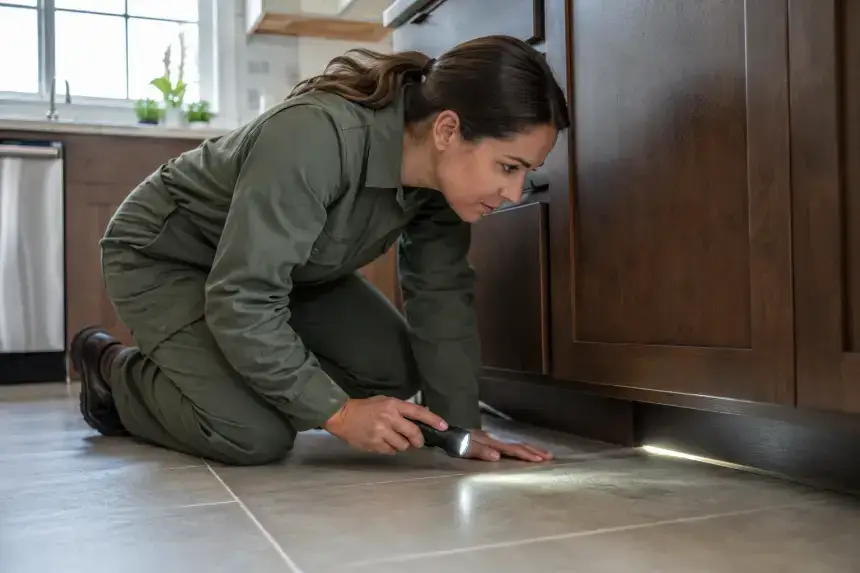
What works is the boring version: knocking down webs and egg sacs, treating the harborages, and cutting the prey supply — the light by the door, the damp corner, the gap under the garage door.
When to stop trying and call
- You have found a black widow or a brown recluse — the two of medical concern.
- Egg sacs in more than one place, or webs coming back within days of clearing them.
- Webs in living space rather than the garage, basement or eaves.
- Someone has been bitten and the bite has changed since.
- You are seeing them in daylight, on the floor, repeatedly.
- License
- Issued by the state where the work happens, and held by the contractor rather than by this site. Ask which name it is held under — a trading name and the licensed entity are often not the same.
- Price
- Quoted before the work starts, not after. If a technician cannot say what the visit will cost before beginning, that is the moment to stop.
- The call
- Describing what you found commits you to nothing. Nothing is booked until you say so.
- Coverage
- By town, not by region. Pick a state below and work down to the town you are in.
What the visit includes
- 01
Inspection
Inside, around the outside, and in the crawl space or slab edge where the trail usually starts. Identification comes before anything is applied.
- 02
The plan, out loud
What the pest is, what the treatment involves, how many visits it takes and what it costs — explained before any work begins.
- 03
Treatment
Aimed at the nest and the route to it rather than at what you can see. Products used indoors are chosen around pets and children in the house.
- 04
The follow-up
Some jobs need a second visit to catch what hatched after the first. A technician says so up front rather than after.
What to say when you call
- 01Size, color and any marking — a red hourglass underneath, or a violin shape behind the head.
- 02Where: a garage, a basement, a crawl space, an eave, inside a living space.
- 03Whether there are webs, and what shape.
- 04Whether anyone was bitten and how it looks now.
Leave one web where it is if you can until the visit. The shape of a web says more about which spider you have than the insect does once it has run.
Spider Control by state
- Alabama
- Alaska
- Arizona
- Arkansas
- California
- Colorado
- Connecticut
- Delaware
- District of Columbia
- Florida
- Georgia
- Hawaii
- Idaho
- Illinois
- Indiana
- Iowa
- Kansas
- Kentucky
- Louisiana
- Maine
- Maryland
- Massachusetts
- Michigan
- Minnesota
- Mississippi
- Missouri
- Montana
- Nebraska
- Nevada
- New Hampshire
- New Jersey
- New Mexico
- New York
- North Carolina
- North Dakota
- Ohio
- Oklahoma
- Oregon
- Pennsylvania
- Rhode Island
- South Carolina
- South Dakota
- Tennessee
- Texas
- Utah
- Vermont
- Virginia
- Washington
- West Virginia
- Wisconsin
- Wyoming