Services
Termite Control
The damage is done before there is anything to see. Termites eat from the inside out and leave the surface intact, which is why the first sign is usually a floor that has started to give.
(844) 578-3029Licensed technicians. No obligation for the call.
Timing is the part that changes with where you live, and it changes the job rather than the wording: a population knocked back every winter is a different task from one that never dies down.
Pick your state below to get to the town pages, where that is spelled out.
Why termites do not go away on their own
A colony neither pauses nor moves on. It feeds continuously on whatever structural wood it has reached, and the volume it removes compounds — quietly, inside members you cannot see.
The cost curve is the reason to act early. Treatment ends the activity; it does not put wood back. Repair is a separate contractor's invoice, and on an older house it is usually the larger of the two numbers.
Why the can from the hardware store makes it worse
There is no retail product that reaches a subterranean colony. The nest is in the soil, often yards from the house, and the workers you can see are a fraction of it.
Knocking down the mud tubes achieves nothing except removing the evidence an inspector would have used. The colony rebuilds them in days, sometimes somewhere you will not look.
Two approaches work: a treated soil barrier, or a baiting system, and both are applied around the structure rather than at the damage. Which suits a given house depends on the foundation, and that is an inspection question.
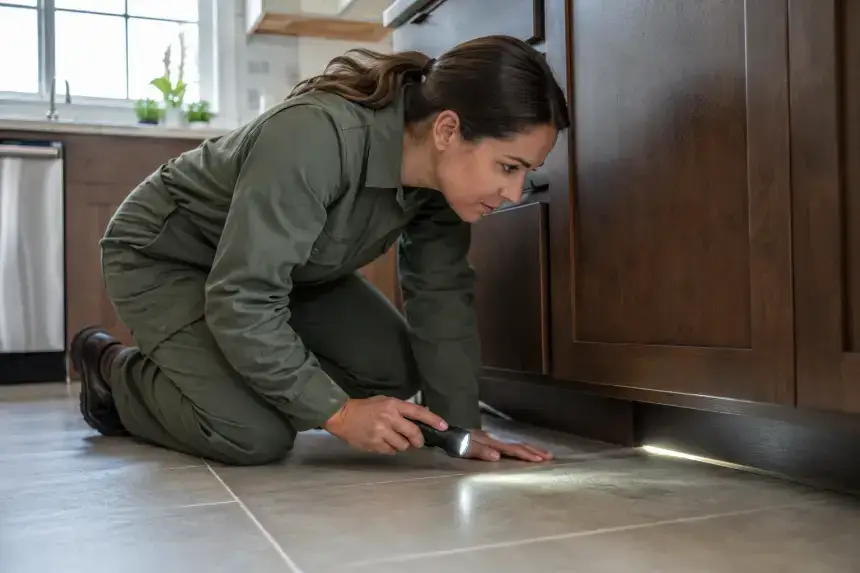
When to stop trying and call
- Mud tubes on a foundation wall, a pier or a crawl space joist.
- Discarded wings on a windowsill or in a spider web indoors.
- Wood that sounds hollow, or paint that looks blistered along a line.
- A floor that has started to give, or a door frame that has moved.
- You are buying, selling or refinancing and need the report.
- License
- Issued by the state where the work happens, and held by the contractor rather than by this site. Ask which name it is held under — a trading name and the licensed entity are often not the same.
- Price
- Quoted before the work starts, not after. If a technician cannot say what the visit will cost before beginning, that is the moment to stop.
- The call
- Describing what you found commits you to nothing. Nothing is booked until you say so.
- Coverage
- By town, not by region. Pick a state below and work down to the town you are in.
What the visit includes
- 01
Inspection
Inside, around the outside, and in the crawl space or slab edge where the trail usually starts. Identification comes before anything is applied.
- 02
The plan, out loud
What the pest is, what the treatment involves, how many visits it takes and what it costs — explained before any work begins.
- 03
Treatment
Aimed at the nest and the route to it rather than at what you can see. Products used indoors are chosen around pets and children in the house.
- 04
The follow-up
Some jobs need a second visit to catch what hatched after the first. A technician says so up front rather than after.
What to say when you call
- 01Which of these you found — mud tubes, wings, pellets, hollow-sounding wood.
- 02Where it is: foundation, window frame, crawl space, deck post.
- 03Whether you saw a swarm, and whether it was inside.
- 04Whether a sale or a refinance is involved, because the paperwork changes the timing.
Leave the mud tubes alone before the visit. They tell an inspector where the colony is entering and whether it is active — and the colony rebuilds them within days anyway, often somewhere you will not think to look.
Termite Control by state
- Alabama
- Alaska
- Arizona
- Arkansas
- California
- Colorado
- Connecticut
- Delaware
- District of Columbia
- Florida
- Georgia
- Hawaii
- Idaho
- Illinois
- Indiana
- Iowa
- Kansas
- Kentucky
- Louisiana
- Maine
- Maryland
- Massachusetts
- Michigan
- Minnesota
- Mississippi
- Missouri
- Montana
- Nebraska
- Nevada
- New Hampshire
- New Jersey
- New Mexico
- New York
- North Carolina
- North Dakota
- Ohio
- Oklahoma
- Oregon
- Pennsylvania
- Rhode Island
- South Carolina
- South Dakota
- Tennessee
- Texas
- Utah
- Vermont
- Virginia
- Washington
- West Virginia
- Wisconsin
- Wyoming